Private, compliant AI for businesses that handle client data

We build AI features into software that handles personal and confidential data, and we design the infrastructure under them to keep that data in the jurisdictions where it has to stay.

Book a call

Based in Vancouver, BC. Shipping production software since 2011.

Questions to answer before client data goes into an AI tool

Your counsel or compliance team decides which rules apply to you. These are the questions we would ask so the system can be built to their answers.

Where does the data have to stay?
Data residency means the data is stored in a set location. Data sovereignty means it is subject only to the laws where it is stored, and that is the harder requirement.
Does it matter who owns the provider?
The US CLOUD Act lets US authorities compel data from a US-headquartered company wherever the data sits, including in that company's datacentres in Toronto or Frankfurt. Model providers such as OpenAI, Anthropic, and Google are US-headquartered. European providers like Mistral are not.
Who is allowed to see it?
If your AI vendor runs on another company's cloud, that company handles the data too. US banking guidance expects banks to understand the risks of that company as well, and a HIPAA Business Associate Agreement with an AI vendor should cover that sub-processor.
What ends up in the prompts?
Personal information can end up in a chat. On Crystal aOS, Microsoft Presidio strips it out when it appears.
What records do you need to keep?
A self-hosted setup can log each AI request with a timestamp, the user or service that made it, and token counts. Whether the prompt and answer text is logged too comes down to your retention policy and your regulator.

Setups we can build

The right one depends on what your regulator requires and who you need to protect the data from.

A cloud AI API in the right region, under signed agreements

You pick a regional deployment, sign the Data Processing Agreement and a Business Associate Agreement where one applies, and document the risk you accept. It can be enough when your regulator accepts contractual controls and your compliance team has signed off on the risk that remains.

A dedicated cloud deployment

Services like Azure OpenAI provisioned throughput and Amazon Bedrock dedicated throughput run on reserved capacity, isolated from other tenants. The provider's jurisdiction stays the same as with the shared API.

Open models on in-country cloud

Some regional cloud providers host open-weight models behind an API on domestic servers. That keeps data in the country without buying hardware, though a provider with a foreign parent still answers to its home jurisdiction.

Models on hardware you control

You own the servers, the models, and the network, run by a domestic entity. It means buying GPUs, paying for a facility, and keeping a team to run it. We have run self-hosted blockchain nodes across Canada and Europe for several years, and our team can travel on-site to install and configure hardware.

A system can also mix these and send each task to the model that fits it.

Work we have shipped

Crystal aOS

Crystal aOS

Secured significant seed funding through private equity & Techstars

This was a concept-to-production engagement that produced a pitch deck, MVP, and the eventual product. The MVP attracted private investment and the platform later joined Techstars with additional seed funding.

Case study

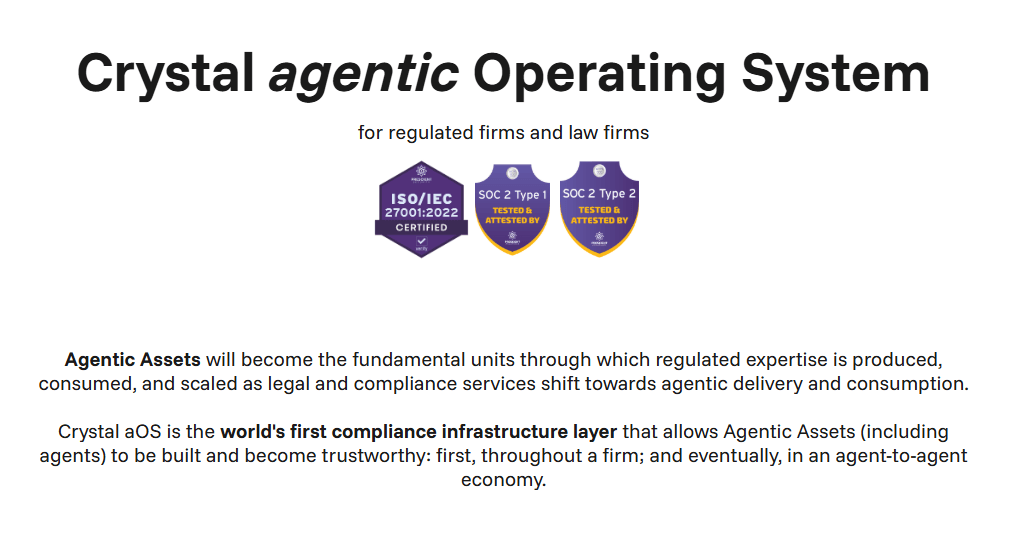
Crystal aOS is an AI legal compliance platform for crypto law firms. We built it from concept and pitch deck through to production. Legal teams search a curated library of regulatory documents and get answers with citations, and they build their own compliance assessments with human approval steps. Firms manage permissions per matter. Crystal aOS is live with ISO/IEC 27001:2022 and SOC 2 Type 1 certifications.

“Graham moved us from playing with AI to production system in days. The capabilities are amazing but care in how he set us up was even better. The solution is persistent but respects privacy.”
Miles Estee, Google review

What happens on the call

  1. 01

    Pick a time

    Choose a slot in the booking calendar.

  2. 02

    Tell us what you need

    Say what you want AI to do and where your data is allowed to go, and we will say whether we can help.

  3. 03

    Map it before any code

    If we are a fit, we map the problem, the users, the data, and how success is measured. Some projects need AI less than expected, and we tell you which applies before any code is written.

Questions

Can we use ChatGPT or Claude with client data?

That depends on your rules and on the plan you are on. Under HIPAA, a provider that receives health data in a prompt has to sign a Business Associate Agreement, and some providers' default API access is not covered by one. In the EU, sending personal data to an AI API outside the EEA needs a valid transfer mechanism and a Transfer Impact Assessment. Your counsel or compliance team decides what applies to you.

Does our data have to stay in our country?

Not always. PIPEDA does not currently require data to stay in Canada, the GDPR and UK GDPR do not require it to stay in the EU or UK, and HIPAA says nothing about location. They set conditions on transfers and on the companies that handle the data, and some rules add steps. Quebec's Law 25, for example, requires a Privacy Impact Assessment before personal information leaves Quebec.

Is a Canadian or European datacentre enough?

A local datacentre meets residency. When the provider has a US parent, the CLOUD Act can still reach the data, and holding your own encryption keys does not fully close that gap because the provider still holds metadata and logs. Whether that risk is acceptable depends on how your data is classified and what your regulator requires.

Should we run our own model?

Running your own model keeps the data on hardware you control, and it costs GPUs, a facility, and people to keep it running. At low or bursty volume, idle hardware can cost more than API fees, and our guide suggests proving a use case on a cloud API first. The leading proprietary models also report higher benchmark scores on the hardest reasoning tasks. Before you decide, we can run a sample of your real prompts through both and compare the answers.

Who owns the code?

You do. We deliver the source code, infrastructure-as-code, and documentation, with no proprietary framework you would need us to maintain.

Tell us what you need to protect.

We will tell you what it takes.

Book a call

Rather write?

Book a call